From Bluetooth Specification to TypeScript: Building an FTMS Protocol Codec

3 min read

How I turn Bluetooth FTMS bytes into typed values, wire-valid control inputs, and useful warnings.
Contents
- From a public protocol to code
- The byte-level translation
- Commands are not a BLE client
- What I tested
- Closing thought
From a public protocol to code
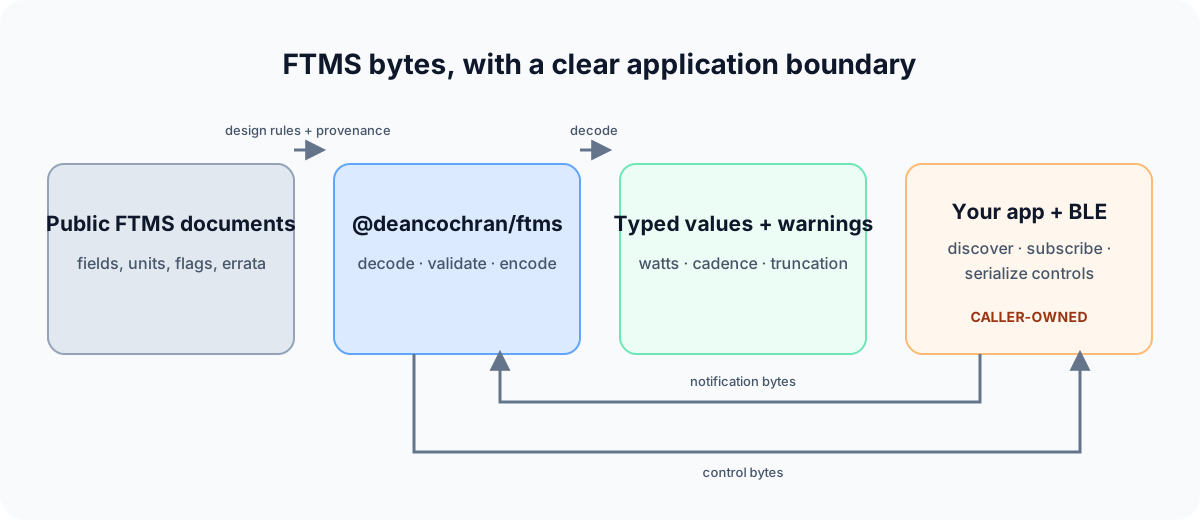
I built @deancochran/ftms to read and write Fitness Machine Service (FTMS) bytes as TypeScript values. Its boundary is deliberate: it accepts Uint8Array or ArrayBuffer, decodes measurements, validates control inputs, encodes requests, and reports useful warnings.
It is not a BLE client. Callers own discovery, subscriptions, operation ordering, timeouts, response matching, and user safety. The package makes no qualification, PTS, or universal-device-compatibility claim.
I worked from FTMS 1.0 and the public GATT Specification Supplement repository, pinned at 3b58acd4d2446e68f5539acac46c3b4941a34747. ESR11 supplies the resistance and cross-trainer corrections I used. Correction 23224 changes conformance language, not byte layouts.
The byte-level translation
FTMS flags select fields; selected fields must be read in the specified order. In this Indoor Bike payload, 0x0044 has bit 0 clear, so instantaneous speed is present; bits 2 and 6 add cadence and power. 0x03e8 is 10 km/h, or about 2.78 m/s; 0x00b4 is 180 half-rpm, or 90 rpm; and signed 0x00fa is 250 W.
import { parseFtmsIndoorBikeMeasurement } from '@deancochran/ftms'

const measurement = parseFtmsIndoorBikeMeasurement(
    Uint8Array.of(0x44, 0x00, 0xe8, 0x03, 0xb4, 0x00, 0xfa, 0x00)
)

measurement.metrics.speedMps // about 2.78
measurement.metrics.cadenceRpm // 90
measurement.metrics.powerWatts // 250
That ordering rule prevents a missing optional field from shifting every later value. Decoders also surface cases such as truncation, reserved flags, unavailable values, trailing bytes, and More Data; callers decide how to present or recover from them. More Data is not automatically reassembled because that needs connection-level ordering and timeouts.
Commands are not a BLE client
A control request is wire-valid, not automatically machine-authorized. For example, target power 250 encodes as [0x05, 0xfa, 0x00]: opcode 0x05, followed by a signed 16-bit value in little-endian order (least-significant byte first).
import { tryEncodeFtmsControlRequest } from '@deancochran/ftms'

const encoded = tryEncodeFtmsControlRequest({
    op: 'setTargetPower',
    powerWatts: 250,
})

if (encoded.ok) {
    console.log([...encoded.value]) // [0x05, 0xfa, 0x00]
}
Before sending it, callers check features and ranges, send only one Control Point procedure at a time, wait for the matching indication, handle timeout, disconnect, or permission loss, and gain appropriate user confirmation. Encoding a command cannot make it safe to perform.
What I tested
My regression evidence covers six machine-data parsers, status and control codecs, and versioned JSON examples with a schema. The cases include malformed, truncated, reserved, and unavailable data. I also check the packed artifact, browser bundle, and TypeScript consumer. This is regression evidence, not Bluetooth qualification or device-interoperability proof.
Closing thought
The useful work is keeping public tables, bytes, units, and tests close together. The codec owns the translation; the application owns the Bluetooth conversation and the person using the machine.